Tuesday, February 17, 2015

Valentine's Day Mailboxes and Post Office

It has been some time since I had a moment to sit down and write a blog entry. As I work this morning at 4:00 am unable to get back to sleep, I thought it the perfect time to reflect on the weeks past. Sometimes it seems almost impossible to incorporate the projects that I did before the Common Core Standards, but we did manage to do a design challenge for Valentine's Day. I spruced it up, and it can be found at Valentine's Day Mailbox Challenge.


I started by giving the PPT presentation on what I expected from my students mailbox designs. We looked at different types of mailboxes and discussed characteristics. I threw in some very funny ones that took on the features of animals and superheros to inspire them to think big.

Then, we visited our STEM lab and got to work designing. They turned out excellent.

I placed them in my cubbies so that they were out of the way, but easy to access.

To take it even further, we mailed our valentines in a post office activity. Each students takes a role as a worker at the post office or a mailer of valentines. They run through their roles of stamping, sorting, mailing, and distributing mail until they are replaced. The process is very smooth and all students get to do all jobs. I am working on attaching this part of the project to my TpT Mailbox Challenge. The students really loved it. Everyday they would ask me, "Are we doing post office today?" I was very exciting to have them act so enthusiastic toward the game that turns out to match with our social studies unit on "Goods and Services". Students learned how things can be exchanged for money specifically buying stamps. They are learned the specialized work that people do in the area of mail and banking.

Students are lender money by the bank so that they can purchase their stamps to mail their letters.

Alphabetical sorter for mail

I made my very own mailbox using two boxes stacked onto of each other and covering them with blue paper. I took screen shots of the post office sign. 


Students buy stamps.

The mailman collected mail from the sorting bins.

One of my students putting letters in the mailboxes.

One of my student mailing letters.

Someone gets a loan for stamps for their valentine, and another student lends out money and uses a checkbook to keep track. 


On Valentine's Day, the students took their mailboxes to their desk and read all of their mail. There were some mistakes of mail not making it to the right mailbox, but for the most part, it was a great success.

Thursday, January 29, 2015

Being Big

Today, my Project Cornerstone moms came to read to my class and teach a lesson. Project Cornerstone is a program ran by the YMCA that helps promote a great classroom and school community. It allows parents to be a support system for optimal physical, mental and emotional development. During this month's Project Cornerstone lesson, my class was asked what it means to "BE BIG". "Being Big" is treating yourself and others with respect. They use the words "being big" because children always want to be bigger and older and more mature. They also use these words because big kids are supposed to treat themselves and others with respect.  I love the idea of "Being Big", I use these words all of the time when students need to be respectful to me, themselves, and others. They are learning what it means to grow up. Growing up does not just mean getting older, moving grades or getting taller and stronger. It also comes with mental and emotional responsibilities. As any supportive adult in a child's life, I want my students to grow into kind, generous, and honorable young adults and adults. I love that my school has amazing parents that want to be involved in their child's life and the lives of all of the children in their child's class. These parents understand the importance of teaching kids ways to respect themselves and others. Behaviors need to be taught. Children need to watch and learn from adults that they trust. This is why Project Cornerstone is so important. If you see a Project Cornerstone parent around school, stop and thank them. They are helping to guide your child toward being comfortable and confident with who they are and making choices that reflect this attitude.
Room 8 is learning how to be big. These are all of the pledges that my students made to help them be big in 2015!

Wednesday, January 21, 2015

Martin Luther King Jr.

The three day weekend has come and gone, but I wanted to remember the hero that helped change the way people were treated in this country. Dr. Martin Luther King Jr. was an ordinary man who did extraordinary acts of bravery. All last week and this week, my first graders talk about, write about, and listen to stories about this ordinary hero. My hope is that they understand that ordinary people can be heros. Dr. Martin Luther King Jr., Rosa Parks, and Ruby Bridges were ordinary, but because they had the courage to do what was right, they are considered heroes. When learning about these amazing people, I want my students to start to understand that if they choose to have the courage to what is right especially around bullying, that they are being heroes.

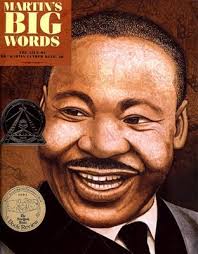
We read Martin's Big Words, a picture book about his life. His words captivated people. He is considered one of the greatest public speakers in the history of the United States. The book is filled with words like inspire, freedom, togetherness, love, dream, etc. We spend time trying to define these words, and I talk about their importance to the Civil Rights Movement. The artwork is award winning and the story is simple enough to reach the younger students. You can find the story read for you on youtube if you click below.

After we have discussed Dr. Martin Luther King Jr.'s life, we discuss his dream for the future. I ask my students to think about their dreams for themselves and the world. We brainstorm what they want for the future. They think of everything. It really shows that they understand the issues in todays world like pollution, traffic, deforestation, extinction, oil spills, hunger, war, homelessness, etc. It always surprises and amazes me when we create our list. Although they are young, they listen when adults discuss issues going on in the world. They observe their environment. They have their own opinions and ideas for how to make the world better. They are optimistic. It comforts me to know that the next generation cares about the world we live in. 

The students write a paragraph discussing three of the ways that they want to improve themselves or the world. I give them a choice because some students really want to become excellent readers while others want to talk about ways to improve upon todays current pollution issue. Both choices speak to the determination of my young students to make things better. 


We complete a craftivity to accompany the writing. The students create a Dr. Martin Luther King Jr. figure complete with suit and tie. They are all different, but equally as adorable. 

Thursday, January 15, 2015

Snowy Day Inferencing

Inferencing Investigations

In the month of January students become investigators. It is their job to use clues from stories to infer what a character is doing and how a character is feeling. I start off by using "Inferencing Investigation" by Babbling Abby. This activity requires the students to listen to a story about a boy and his grandmother. The story leaves out details from their snowy day activities. It is the students' job to infer what the boy did with his grandmother based on clues in their "Snow Day Case File". I split the class up into five different groups. Each group has their own case file that they use. The clues from each file go with other clues, but the students do not realize this until we come back together and talk about what they found. 

Some of the clues have times attached to the event, so we were able to create this timeline. Each child chose one event and illustrated it. 


There was a writing component to this project as well. Students were instructed to choose one piece of evidence and the matching inference to create a sentence using the frame "Based on _______, I  infer that ________________________________."  These are samples of the wonderful writing and illustrations that my students produced. 

Wednesday, January 7, 2015

Nick Bruel Author Visit


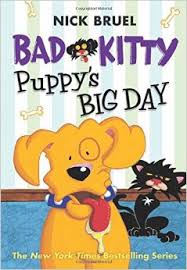
Today, we were visited by the author Nick Bruel, who is the author of the Bad Kitty series. He presented his new book Bad Kitty: Puppies Big Day, which came out today, January 6th, 2014. Mr. Bruel discussed where he gets his ideas for his books. To our surprise, he starts all of his books by simply coming up with a title! Who knew! Then he explained how he with the title Bad Kitty, before creating the story of Bad Kitty. After he came up with multiple events in the stories, he put them in order alphabetically, and the Bad Kitty books were born. As an aspiring author, I loved learning how he started his books.

For a majority of the assembly, Mr. Bruel worked with all of the students to come up with a story called Mad Horse. He went through an exercise with the students where he asked them many questions in a rapid fire way, and called on students to answer. He took whatever was said to him and incorporated it into the story. Here is what the students came up with...

Mad Horse
Mad Horse lived on a farm, but he did not like the other animals because they are mean to him. He got very mad when they were mean to him. He was running away from the farm to the city.  The city was five hundred million miles away. He decided to get on a plane, but he didn't have any money. So then, he jumped on a train to go to the city. He was not supposed to be on the train, so he was kicked off. He needed a miracle. Santa arrived because one of his reindeer had fallen off and he needed Mad Horse to help him. Santa sprinkled pixie dust on Mad Horse. They went to the city together. When he saw his cousin, he was happy and they talked and talked and talked.

He finished by telling students what the secret to writing a story is.

"This is the secret to writing stories. Always ask yourself questions."

I was very impressed by the presentation and so happy that I took my class to go see him. I would encourage all teachers to try to get an author to visit. This was our second author visit this year! I hope that this visit will encourage my students to be patient writers.

Monday, December 29, 2014

Hour of Code- Holiday Style

This year, Almond embraced the "Hour of Code". We signed up with our buddy classes to code together. The assignment was to make a holiday card using Scratch. The students needed to choose a background and insert it into the card. Then, they needed to choose at least one character and insert the character into the card. The final instruction was that the character must move. Many students programmed the character to move and say "Happy Holidays". With Scratch, students can program interactive stories, animations, cards, etc. It is free of charge, and I encourage all parents to go on and set up an account for your child. There are two versions, Scratch for 3rd grade and up and Scratch Jr. for TK-2nd. It really gave our buddy groups a chance to work collaboratively, the 4th graders helping the 1st graders and vice versa. It was amazing to watch them create some very cool cards.

This is what the program looks like while the students are still programming their interactive cards. Our lab was open during the week so that parents could come and work with their children on the program too!


There are so many options. The students can really explore and be creative. There were no direct instructions given. The students really had to figure it out on their own. I was amazed at the problem solving skills and the patience of my 1st graders. 


The Holiday Season

It is halfway through Christmas break, and I am now finding the time to update my blog. My son is down for his nap, and my husband is off working out at the gym. The only sound I hear is the snorting of our little frenchie, Emma, who just last week was spade. We have had a wonderful break so far. Christmas was very busy. We had three Christmases this year. The day started out at my husband's mom's house for breakfast, which was delicious. Then, we moved on to my parent's house. Finally, we ended the night at my husband's dad's house for dinner. Everyone was invited to dinner, so it was so much fun! At the start of the day, I was not in the Christmas mood, but by the end of the night, I wished that the holiday season would continue, which is probably why I continue to watch Hallmark holiday movies.

Before school let out, we were so busy. I have decided to tackle everything in one blog post because I do not know when my next free moment will be. As you might experience, after Christmas is spent getting together with friends that were traveling during the holiday or are visiting from out of town. Each night this week seems to be filled with a dinner.


We work on two major projects during the holiday season. First, in Language Arts, we focus on the story of the Gingerbread Man. We read various versions and do different activities. One of the activities that I love is a gingerbread man glyph. The students answer questions about themselves and create a gingerbread man to match how they answered. For example, the gingerbread vest color corresponds to their student's favorite season. The students learn about each other and have fun doing it.

We do many other activities including sequencing, character analysis, problem and solution, etc. We also write a paragraph on "how to catch the gingerbread man". 


From the beginning of December to the break, we take a trip around the world in social studies. We learn about continents and countries, traveling to different places to see how they celebrate the holiday season. The students receive a passport and suitcase for the journeys. Each country is found on a map and colored. Each students gets a sticker for visiting each country, and they color the countries flag to place on the outside of their suitcase. 

Many backpackers do something similar. When they travel to different countries they buy patches to sow onto their large backpack.  Before I became a teacher, I backpacked across South America with a friend who is now a teacher in England. I saw many backpacks adorned with patches from all over the world. It is incredible how traveling changes a person. Maybe I will write about my travels in a different blog entry, but traveling is one of my passions and definitely a hobby of my husband and mine.

We visited Mexico, France, Germany, Israel,  and the United States of America. We started in Mexico and learned about Las Posadas. Then, we went to France and learned about Pere Noel and Le Creche. After that, we went to Germany and learned about Christmas trees and St. Nicholas Day. When we traveled to Israel we learned about Hanukkah. Finally, in the USA we discussed Kwanzaa. Each country and holiday came with an article and comprehension sheet. We also did a craft to represent something that we learned.


This poinsettia represented "Las Posadas" when people decorate their homes with this beautiful flower. Legend has it that a girl wanted to bring a gift to the baby Jesus and only had weeds, but an angel changed them into a red poinsettia. The poinsettia was a new flower and considered a Christmas flower from the beginning. 
The students drew these with guidance. They turned out beautiful. I followed these instructions found at Art Projects for Kids.


We incorporated math into the creation of a Christmas tree to represent Germany. 
I cut different length strips and had students line them up from longest to shortest. Then, they were allowed to decorate them with ornaments. The last step was to add falling snow to the night sky. 


Germany is credited for starting the Christmas tree tradition that we have today. Although, evergreens were used for centuries before that, dating back to before the Egyptian Dynasties. Egyptians worshiped Ra the sun god. During the winter when the days were shorter, the sun god was said to be sick, but when the winter solstice arrived, it marked the time when the sun god would get better. Many people used evergreens to remind them of the time when all the green plants would grow again after the winter solstice. German's decorated trees in their homes and outside. It is also widely believed that Martin Luther, the reformer who started the Lutheran religion, was the first to put candles on a Christmas tree. Today, we use lights instead of candles. My family is Lutheran, so as a child, I grew up with the story of Martin Luther. It made me excited to be both German and Lutheran. It also made me love Christmas trees because they represented a part of my heritage during the Christmas season. 

It is my hope, that during this unit, every student learns something about their culture and a friends culture. I want them to understand that culture is important. We are all American, but there is another part to who we are. I learned to embrace my German heritage, taking the bad with the good. I want my students to want to explore their heritage and love where they come from.